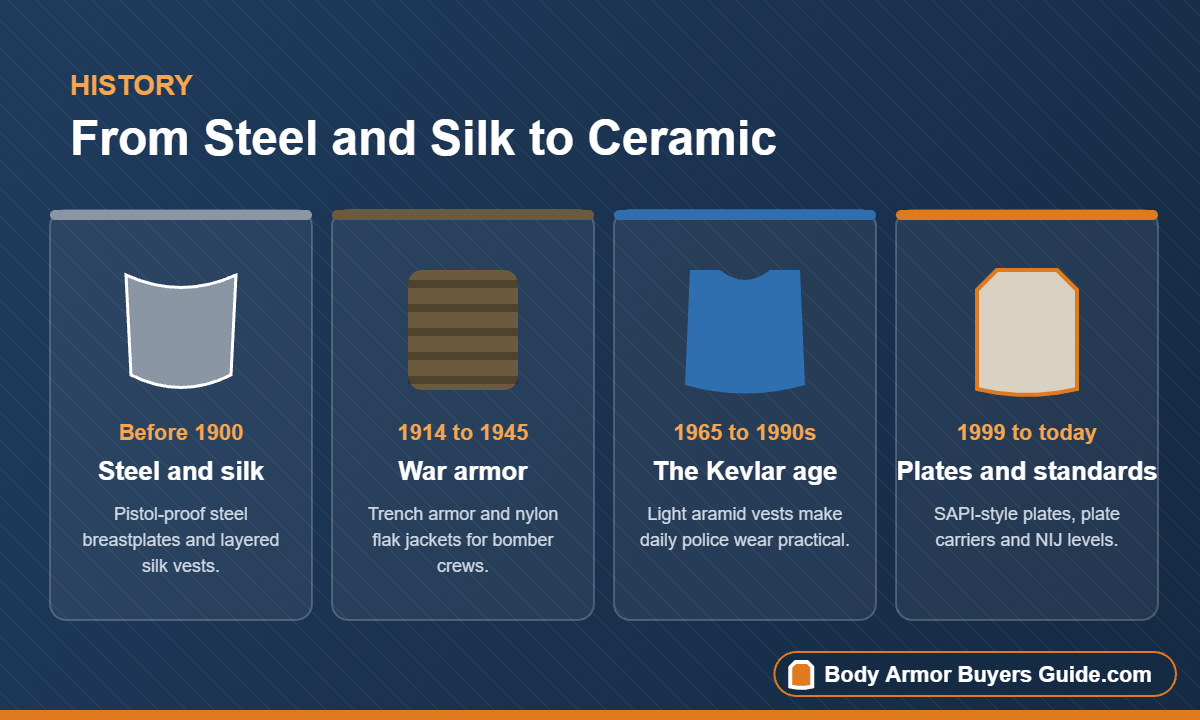
People have tried to stop weapons with armor for thousands of years. The story of modern body armor runs from steel breastplates and silk vests to today’s light ceramic and polyethylene plates.
Steel and silk
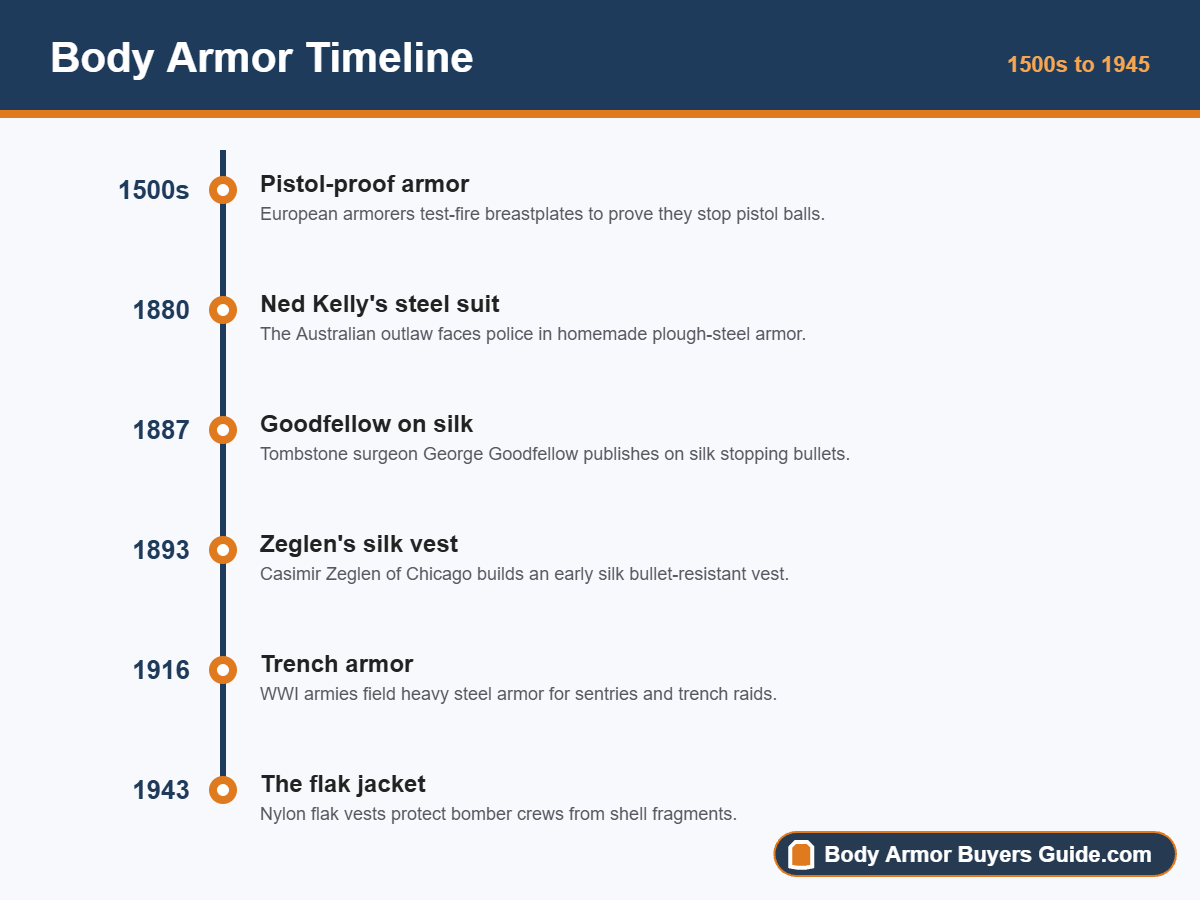
As firearms spread in the 1500s, European armorers began test-firing breastplates to prove they could stop a pistol ball. Centuries later, in 1880, the Australian outlaw Ned Kelly faced police in homemade steel armor.
In 1887, Tombstone surgeon George Goodfellow wrote about silk slowing or stopping bullets. In 1893, Casimir Zeglen of Chicago built an early bullet-resistant vest from layered silk. It worked against the slower bullets of the day but was very expensive.
Two world wars
World War I armies tried heavy steel armor for sentries and trench raids, but it was too heavy for most troops. In World War II, nylon flak jackets were made for bomber crews. They stopped shell fragments, not most bullets.
The Kevlar age
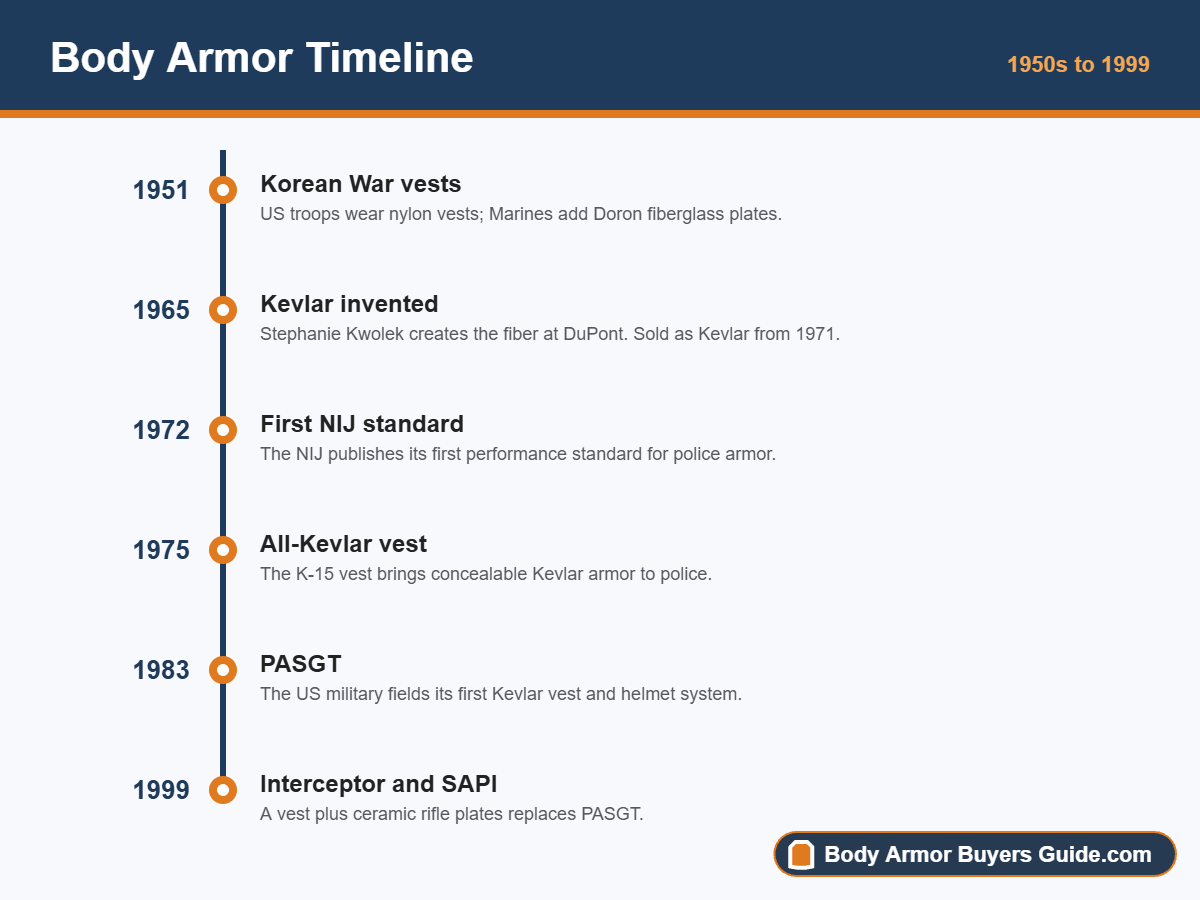
In 1965, Stephanie Kwolek invented the fiber that DuPont sold as Kevlar starting in 1971. Testing for police soon followed, and in 1972 the National Institute of Justice published its first armor standard. By 1975, all-Kevlar vests like the K-15 made concealable armor practical for daily police wear.
The US military fielded its first Kevlar vest and helmet, the PASGT system, in the early 1980s.
Plates, carriers and standards
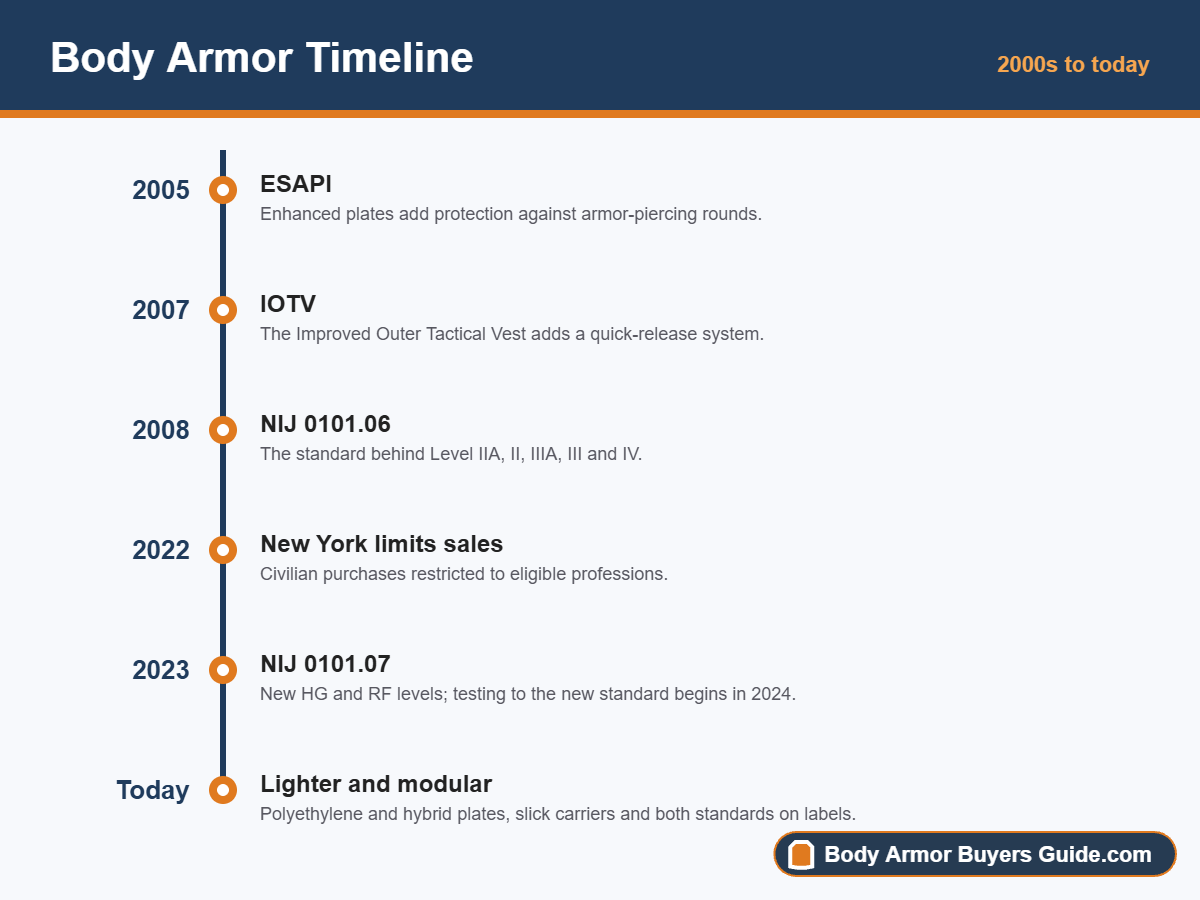
In 1999, the Interceptor system paired a soft vest with ceramic SAPI rifle plates. Enhanced ESAPI plates followed in the mid-2000s. On the civilian side, NIJ 0101.06 set the familiar Level IIIA, III and IV names in 2008, and NIJ 0101.07 introduced HG and RF levels in 2023. In October 2026, a federal court ruled New York’s civilian purchase ban unconstitutional, a first for body armor under the Second Amendment.